Thursday, 10 October 2013

New Book - Andrés Quero-Sánchez, Über das Dasein

A new book, Andrés Quero-Sánchez, Über das Dasein: Albertus Magnus und die Metaphysik des Idealismus, Meister-Eckhart-Jahrbuch Beihefte 3 (Stuttgart: Kohlhammer, 2013), has just ben published.  This volume, the author's habilitation, skillfully traces the metaphysics of Idealism through Henry of Ghent, Thomas Aquinas, Dietrich of Freiberg, Meister Eckhart, and later Schelling and Hegel, before making an assessment of the 'realistic metaphysics' of Albert the Great.  This large volume (812 pages) offers an enormous contribution to the field.

More information about the monograph, along with the table of contents, foreword, and a sample from the introduction, can be found on the publisher's website.

PD Dr. Andrés Quero-Sánchez works as part of the research group for "Religiöse Individualisierung in historischer Perspektive" at the Max-Weber-Kolleg of the University of Erfurt.  He also teaches philosophy at the University of Regensburg.

Monday, 30 September 2013

1313-2013 - LES 700 ANS DE L’ARRIVEE D’ECKHART A STRASBOURG

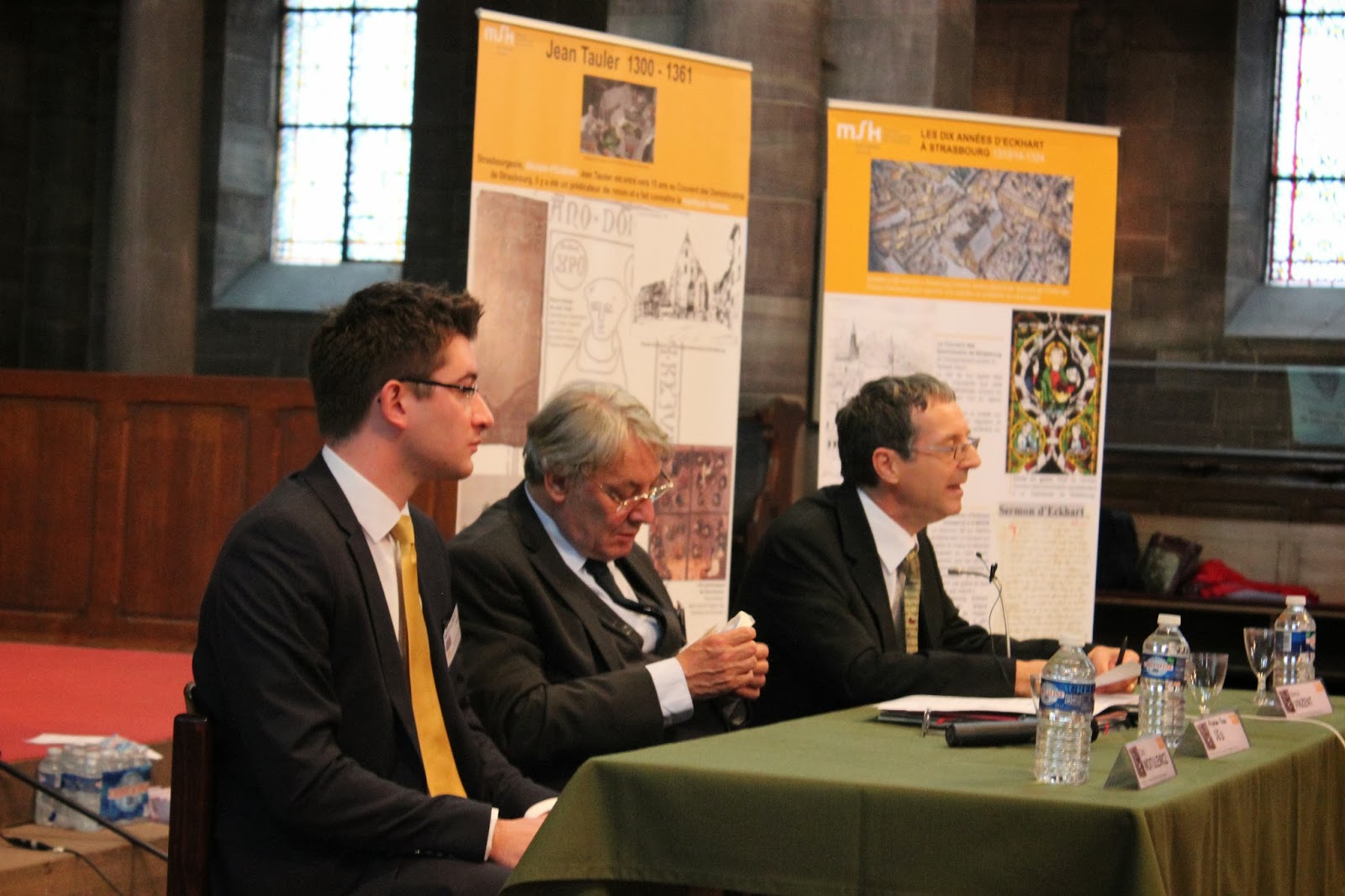
The project members (Professor Dietmar Mieth, Dr Chris Wojtulewicz, Ian Richardson, Professor Markus Vinzent) have spent two fascinating days in Strasbourg on the Colloquium '1313-2013 - LES 700 ANS DE L’ARRIVEE D’ECKHART A STRASBOURG' at Strasbourg, Temple Neuf, place du Temple Neuf
Gymnase Jean Sturm.
The Conference was organized by Professor Marie-Anne Vannier. Here a few photographs from the conference:

Strasbourg Cathedral

Professor Mieth giving a toast on the host

Professor Ann-Marie Vannier at the Lord's Major's Grand Salon

Professor Mieth addressing the Lord's Major representative and colleagues

Dr Chris Wojtulewicz and Professor Markus Vinzent presenting the AHRC Project's work in progress


The venue: The New Temple of the Dominican monastery, Strasbourg

The Project members, left Professor Freimut Löhser, University of Augsburg, Germany 

Lecture concert with reading of the Granum sinapis


Professor Mieth giving his lecture assisted by Dr Wojtulewicz


Thursday, 22 August 2013

Gelassenheit - Eine Zeitreise zu den mystischen Wurzeln eines Modeworts

Gelassenheit . Eine Zeitreise zu den mystischen Wurzeln eines Modeworts - 08.09.2013
 
Von Ulrich Grober

Die Bundeskanzlerin hat es zu ihrem Markenzeichen entwickelt: Ruhe und Gelassenheit auszustrahlen, gehört zu ihren Stärken. Bundesliga-Trainer üben sich in dieser Haltung.
 

Sendung zum Thema

WDR 3 Lebenszeichen | Sonntag, 8. September 2013, 08.30 - 09.00 Uhr

Kanzlerin Angela Merkel und Peer Steinbrück strahlen Gelassenheit aus WDR Sendung zu Meister Eckhart
Börsenberichte vermelden, dass die Märkte gelassen reagieren, wenn es trotz Turbulenzen gut geht. In Zeiten multipler Krisen hat das Thema Gelassenheit Hochkonjunktur. Aber was ist das, Gelassenheit? Die Suche nach dem Sinn des Wortes führt auf eine Zeitreise in die Epoche der gotischen Kathedralen und in die Sprache der deutschen Mystik. Der Urtext stammt von dem thüringischen Mönch und Philosophen Meister Eckhart. Die Sendung spürt den tiefen Wurzeln des Modewortes nach und stößt auf alte Bedeutungsschichten, die hochaktuell sind.

Redaktion: Christina-Maria Purkert

Saturday, 10 August 2013

English Translation of Meister Eckhart's Sermones et Lectiones super Ecclesiastici 34

Although this work ranges amongst the very important texts amongst Eckhart's Latin writings, except for nn. 42-61 which can be found in the book by B. McGinn, Meister Eckhart, Teacher and Preacher (Continuum, 1987), 174-81, English speaking readers had no access to it.

At our research network blog, the text is being made available in the translation by Patricia Impey (work in progress), which forms part of her PhD on this text. To access the text, go here.


Wednesday, 7 August 2013

Workshop on Thomas of Erfurt and Meister Eckhart on 14/15 November 2013 at the Max-Weber-Kolleg, Erfurt (Germany)

 Schottenkirche - presumably the place where Thomas of Erfurt taught.

Workshop „Thomas von Erfurt und  Meister Eckhart“ / „Thomas of Erfurt and  Meister Eckhart“
Max-Weber-K olleg 14.15. November 2013


Workshop „Thomas von Erfurt und  Meister Eckhart“ / „Thomas of Erfurt and  Meister Eckhart“
Max-Weber-Kolleg 14.15. November 2013
Thomas von Erfurt ist der Verfasser einer an der Universität  Paris führenden „modistischen“ Grammatik (um 1310). Er lehrte in Erfurt, vermutlich an den Stiftsschulen, deren Rektor er zeitweise war, zu der Zeit, als Meister Eckhart in Erfurt als Provinzial der Dominikaner residierte. Es gibt bisher einige wenige Studien über das Einwirken der modischen Grammatik in Meister Eckharts Werk. Der Workshop versucht, hier in interdisziplinärer Kooperation mehr über diese Erfurt-Paris-Beziehung bzw. über Grammatik, Metaphysik und Bibelexegese  in Erfahrung zu bringen.
Thomas of Erfurt is the author of one of the leading ‘modistic’ grammar’s used at the University of Paris (around 1310 AD). He taught at Erfurt University, presumably at the schools of the monastery of the Scots (Schottenkloster), where he may have been the rector at the time when Meister Eckhart was provincial of the Dominicans and resided at Erfurt. So far, only very few studies have been dedicated to the influence of Thomas’ modistic grammar on the work of Meister Eckhart. The workshop, therefore, tries to break into new territory, opening an interdisciplinary field of historical studies and the history of reception, to develop the links that existed between Erfurt and Paris and to broaden our understanding on grammar, metaphysics and the reading of the Bible.
Verantwortlich/directed by Markus Vinzent, Dietmar Mieth
Einheiten/unites: je 30 Min Referat, 15 Min. Nachfragen und Diskussion/each paper 30min with added 15min discussion
Sprachen/languages: Deutsch, Englisch
Titel sind bisher Arbeitstitel, Zusagen der Referenten liegen vor/working titles and agreed speakers see below.
Beginn/start: Do. 14. Nov. 13.30
Ende/end: Fr. 15. Nov 12.30
Programm-Entwurf/draft program:
Do/Th 14.Nov. 2013
13.30  Begrüßung , Einführung/opening, introduction
13.45 Christian Lehmann (Sprachwissenschaft, Erfurt): Die Grammatik des Thomas von Erfurt (The grammar of Thomas of Erfurt)
14.30 Freimut Löser (Augsburg), Paris in Eckharts Schriften (Paris in Eckhart’s Writings).
15.15  Andres Quero-Sanchez (Philosophie, MWK): "Heideggers Verständnis der ›Grammatica speculativa‹ des Thomas von Erfurt in seiner Freiburger Habilitationsschrift (›Die Kategorien- und Bedeutungslehre des Duns Scotus‹)" (Heidegger's Understanding of the 'Grammatica speculativa' of Thomas of Erfurt in his Freiburg Habilitation Thesis ('Duns Soctus' Theory of the Categories and of Meaning')’)
16.00 Pause
16.15  Gesche Linde (Theologin, Darmstadt, Fellow MWK): Thomas von Erfurt bei Charles Peirce (Thomas of Erfurt in Charles Peirce)
17.00 Stephan Grotz (Philosoph, Hamburg): Spuren der modistischen Grammatik in der Metaphysik Eckharts (Traces of the modistic grammar in the metaphysics of Eckhart)
18.15  Abendessen - Buffet
19.30 Oliver Davies (King´s College, London): Meister Eckhart, Language and Neuroscience: a New Opening in the Chinese-Western Conversation
21.00 Ausklang in der City/get together in the medieval town of Erfurt

Fr. 15. Nov 2013
9.00  Claire Taylor Jones (Germanistik, Notre Dame, USA) : The influence of Thomas of Erfurt on Meister Eckhart (Der Einfluss Thomas von Erfurts auf Meister Eckhart)
9.45  Dietmar Mieth (Theologe,Tübingen,  Fellow MWK): Der Einfluss der Modistik auf Meister Eckharts Bibelexegese (The influence of modism on Meister Eckhart’s reading of Scripture)
10.30 Pause
10.45 Chris Wojtulewicz (King’s College, London): Meister Eckhart and Boethius of Dacia (Meister Eckhart und Boethius von Dacia)
11.30 Markus Vinzent (Theologe und Historiker, Fellow MWK): Thomas, Eckhart und Paris (Thomas, Eckhart and Paris)
Anschließend möglich: Ein Weg der Erfahrung mit Meister Eckhart durch Erfurt mit anschließendem Mittagessen in der Stadt.
Perhaps: A tour through the town of Erfurt to the places of Thomas and Eckhart.


Thursday, 25 July 2013

New brochure published: Meister Eckhart - His Continuous Presence

If you want to learn more about Eckhart's university city of Erfurt, the city where he joined the Dominican Order - please order a copy of the new brochure that was published a few days ago via Professor Markus Vinzent:

Meister Eckhart - His Continuous Presence

Text by Professor Dietmar Mieth, trans. by Professor Markus Vinzent and Caroline Patterson.


Wednesday, 29 May 2013

Meister Eckhart and Paris University


Meister Eckhart (ca. 1260-1329) is one of the most widely read medieval philosophical theologians and preachers today, and he was highly influential and controversial in and beyond his times. Only Thomas Aquinas before him was called twice to one of the two Dominican chairs of Theology in Paris. From his Parisian teaching, several documents have survived, but Eckhart's Parisian Questions are regarded as 'one of the most famous set of texts that medieval thinking has produced' (Kurt Flash, Meister Eckhart, 2010, p. 113).

So far we only knew of five such Questions, three that were dated to his first magisterium in 1302/3, the other two to his second in 1311/2. While Professor Markus Vinzent wrote his 'Art of Detachment' (Peeters, Leuven, 2011) and his 'Eckhart's On the Lord's Prayer' (Peeters, Leuven, 2012), he re-discovered four more Parisian Questions that he thought were likely to be authored by Eckhart, but had been excluded as dubious from their first discoverer Martin Grabmann (and all subsequent editors). He presented his findings as invited main lecture at the International Medieval Congress 2010 (published in JTS 63, 2012). Although the re-discovered Questions are already worth a detailed study, the source from where the four derive will shed further light on these questions: The manuscript Vat. Lat. 1086 ranks as a document of crucial importance which will help us understand the development of philosophical, theological and juridicial teaching at Paris in the beginning XIVth century. Prosper's collection contains names and opinions of students, bachelors and masters (regents) of the university and preserves the documentation of a detailed insight into the atmosphere of learning of this European cultural centre as no other document does. For many of the named people, this will be a first scholarly study of their bio-bibliography and their thinking.

Here just a few examples of people who's questions are contained in Ms. Vat. Lat. 1086:
Prosper, Jacques d'Ascoli, Gregoire de Lucques, John de Monte s. Elygii, Gregoire de Lucques, Henricus (de Gand?), Gilles de Rome, Aegidius Romanus, Simon de Corbeia?, Bertrand de Turre, Gerardus de s. Victore, Gregoire de Lucques, Pe<trus> de s<anc>to dyo<nisio>, Henricus Amandi, Jean de Pouilly (142ra1), Jean, de l'ordre du Val des Ecoliers?, Martin d' Abbeville, François Caraccioli or de Caroccis di Napoli, Brito: Raoul Renaud, Gui Terreni or de Perpignan, Durandus, Thomas de Aquino ...

To substantiate the potential authenticity of the four re-discovered Parisian Questions and to read them against the background of the network of University teachers in Paris, contained  in this unique Latin manuscript we hope to gain new insight into the early beginnings of humanist theological and philosophical thinking of Paris University of the early 14th century and of Eckhart's place in this network.
​
To study this towering figure of Meister Eckhart and his early 14th c. humanist environment of philosophy and theology at the University of Paris an AHRC-Major Research Grant (£571.000 for the years 2013-2016) was awarded for the project 'Meister Eckhart and the Parisian University in the early 14th century - Codex Vaticanus Latinus 1086', directed by Professor Markus Vinzent (PI) and Professor Oliver Davies (CO-I). The project includes one postdoctoral researcher (Chris Wojtulewicz), one Phd student and several teams (Professor Walter Senner, Rome with his team; Professor Loris Sturlese, Lecce with his team; Professor Dietmar Mieth, Erfurt with his team and the Max-Weber-Kolleg, Erfurt). The project teams intend to rewrite the history of this time, broadening the textual basis for Eckhart and reading his texts against the background of other, largely unexplored scholars of his time.

The projects address:

Max-Weber-Kolleg
Nordhäuser Straße 74
99089 Erfurt
0361 7372800

magistereckhart at gmail.com